
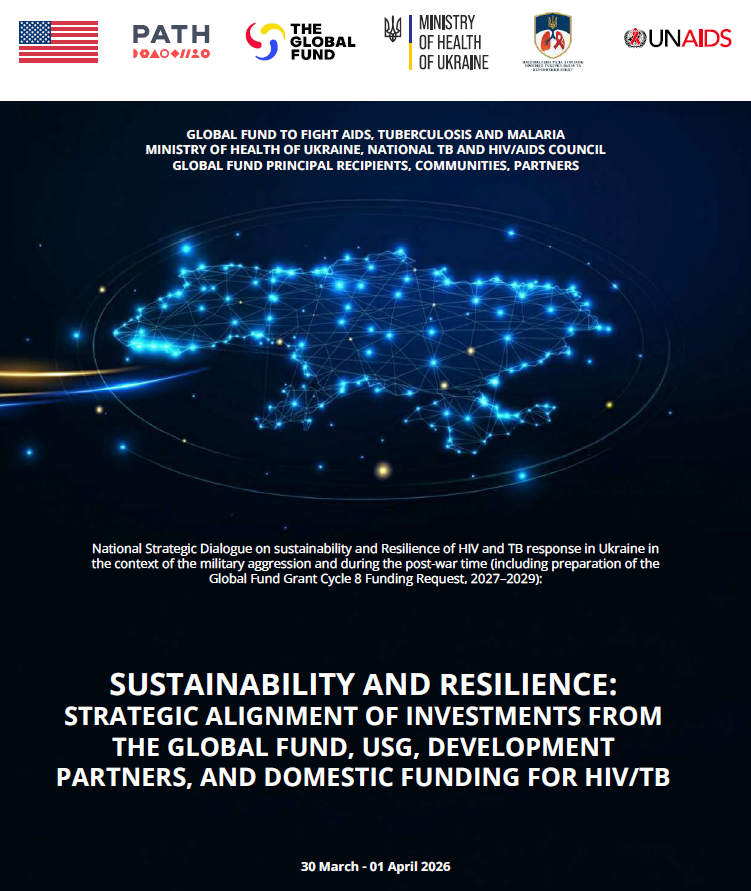
On March 30 – April 1, 2026, a National Strategic Dialogue was held in Ukraine, focused on the sustainability and resilience of the HIV and tuberculosis response in the context of war and the post-war period. The event became an important step in preparing the funding request to the Global Fund within the 8th Grant Cycle (2027–2029).
Representatives of government bodies, international partners, civil society, key populations and communities, as well as Principal Recipients of Global Fund grants and other national and local stakeholders participated in the dialogue.
The objective of the dialogue was to reach a shared vision of strategic priorities to ensure a sustainable, resilient, and integrated response to HIV and tuberculosis in Ukraine in the context of war and recovery, including alignment of domestic financing, donor investments, and preparation of the Global Fund (GC8) funding request.
Particular attention was given to the session “Review of CRG (Communities, Rights and Gender) Priorities for GC8 (8th Grant Cycle)”.
During the session, representatives of the Alliance and partner organizations presented key barriers faced by key populations, discussed community needs in the context of access to services, and identified priorities.
Within the REAct system, data on human rights violations and responses for 2025 were presented:
5,577 cases of rights violations were recorded
53 NGOs, 83 reactors
In 2025, 28% of cases out of the total were registered and received legal support from paralegals of Alliance sub-recipients: All-Ukrainian Association of Women Who Use Drugs “VONA”, CF “Hope and Trust”, CO “Kohorta” → with a plan to exceed 55% in 2026 (with MGR “Partner” replacing CO “Kohorta”).
Among the further priorities within the implementation of the REAct system:
Capacity building of paralegals from partner organizations — Alliance sub-grantees providing paralegal assistance — using the REAct system as a unified digital platform at the Alliance level for monitoring and responding to human rights violations at the community level.
Coordination of efforts with other systems (DataCheck, OneImpact, etc.) to ensure efficient use of resources (human and financial) and complementary responses in the interests of communities.
Cooperation with the Public Health Center of the Ministry of Health of Ukraine to ensure effective transfer and use of aggregated data on barriers to service access documented by communities to inform decision-making processes.
The outcomes of the dialogue will serve as a foundation for further decisions and joint actions aimed at strengthening the response to HIV and tuberculosis in Ukraine.