
Categories
News

Every third drug user arrested is subjected to torture or other cruel, inhuman, or degrading treatment during arrest or detention

Eastern Europe and Central Asia is the only region in the world where new HIV infections among all age groups have continued to rise, according to UNAIDS data.

The policy environment in EECA is dominated by punitive drug laws. People who live with drug dependence are exposed to discrimination based on their chronic health condition, arbitrary arrest, and ill-treatment by the police.

EECA Drugs Regulation
EECA Drugs Regulation

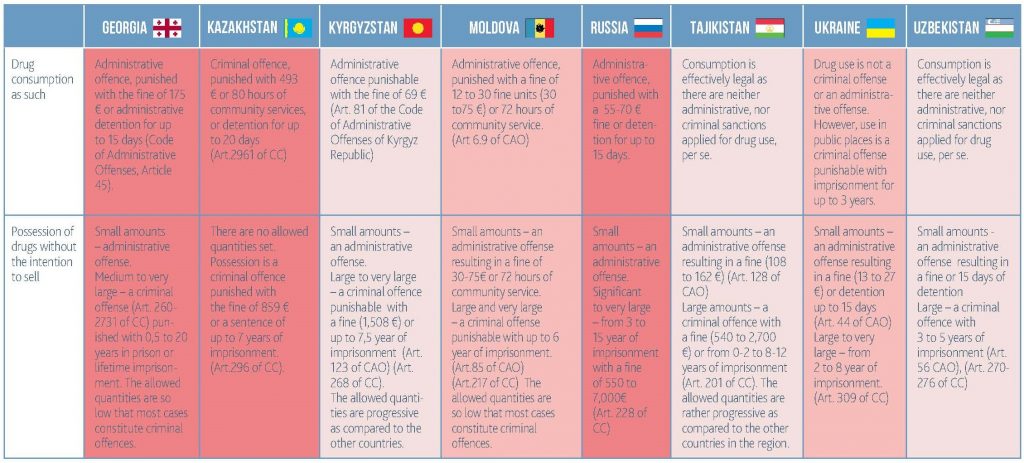
The color scale shows the severity of punishment in the countries’ legislation for drug use and possession for personal use. However, the light color doesn’t mean that
drug users are not criminalized in the country. Rather, in the countries (such as Kyrgyzstan, Tajikistan) where laws related to drug use are quite progressive police
practices on the ground remain quite discriminative against drug users.

Evidence collected in REAct
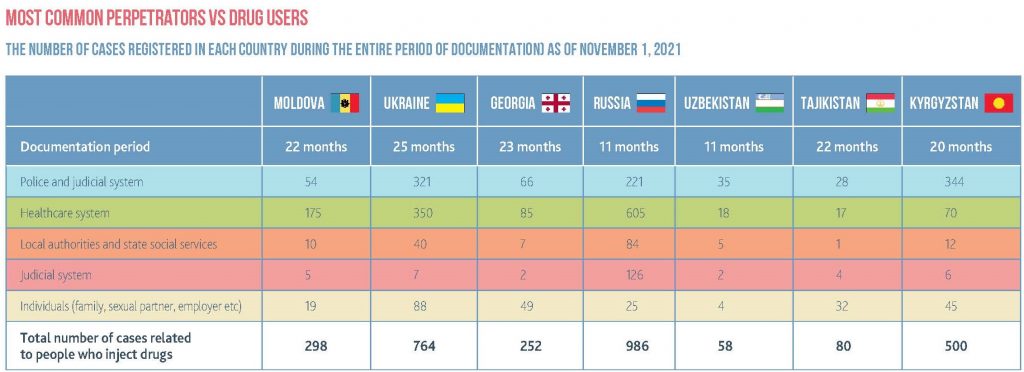
the number of cases registered in each country during the entire period of documentation) As of November 1, 2021

The most frequent violators of PWIDs’ rights are the police (from 18% in Moldova to 68% in Kyrgyzstan) and the healthcare system (from 14% in Kyrgyzstan to 61% in Russia). However, the types of violations are quite different if we compare these two groups of perpetrators.
In respect of the healthcare system, we have recorded such cases as humiliating treatment or denial of health services, which are not so severe and violent as excessive use of force, violence, torture, arbitrary detentions that the police practice on a regular basis against drug users.
The table below shows that the range of violations committed by the police is much broader than those committed by other perpetrators.

All in all, on average one out of every three cases registered in the EECA region, is about the police and law enforcement agencies severely violating fundamental human rights such as the right to life, freedom, bodily integrity etc.
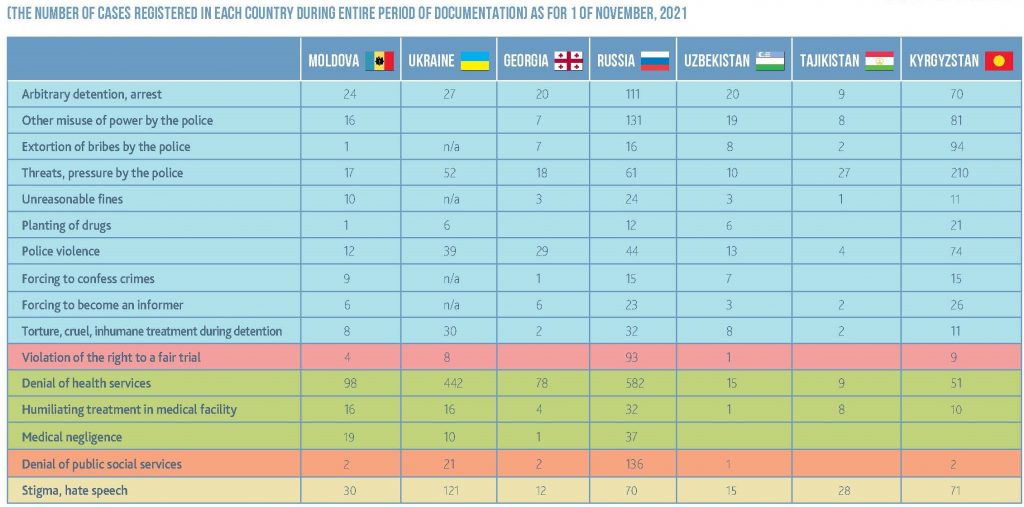
Most common violations in relation to drug users

At a first glance at this table, it becomes clear that most violations take place in healthcare settings. Indeed, 43% of complaints are related to discriminative denial of health services. However, it is important to keep in mind that when a client sought for health services, he/she comes to an NGO, so that a REActor (paralegal) can easily document the case.

Alternately, when a person is detained it is almost impossible to reach him/her with legal services or document such a case, as police officers rarely even let detainees make phone calls. That is why, we believe, the percentage of cases attributable to the
police that we have managed to record are just a small portion of the actual number of violations practiced by the police.

The evidence we have collected proves that violations such as police violence, arbitrary detentions, forced confessions are deeply enrooted in the day-to-day practices of police officers. Such cases should be considered as routine practices rather than rare exceptions.
Read the full report

Drug users and human rights. The situation in Eastern Europe and Central Asia region

Categories
News

Presentation of REAct system performance and cases of successful responses at the webinar on reducing stigma and discrimination of people affected by TB

A webinar on the implementation of measures to reduce the stigma and discrimination of people affected by TB was held on November 23 by “Stop TB. Ukraine” Partnership

During the event, the representatives of non-governmental and national organizations discussed matters related to effective methods and successful experiences of overcoming the stigma and discrimination of people affected by TB. 

Презентація роботи системи REAct та історій успішного реагування на вебінарі щодо зниження рівня стигми та дискримінації по відношенню до осіб з ТБ

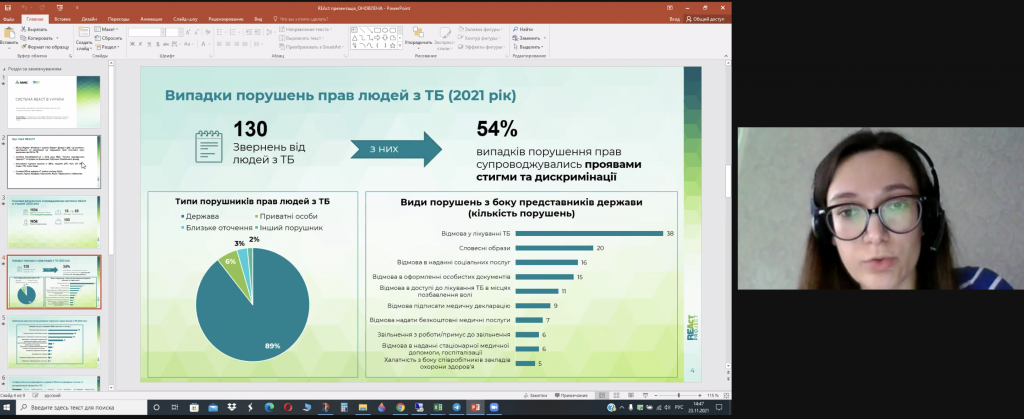
In one of the sessions Nadiia Semchuk, senior specialist of REAct project, presented the work of the REAct system. The speaker noted that as of today, 1694 reports of violations of rights of people vulnerable to HIV and TB, were registered in the REAct monitoring and response system, 77% were fully resolved. Thanks to the work of 69 organizations, the system operates in 18 regions of Ukraine. 

As for the violations of the rights of people affected by TB, 130 reports were received in 2021, 54% of which related to stigma and discrimination. According to the collected data, the majority of cases faced by people affected by TB included refusal to treat TB (38), verbal insults (20), and refusal to provide social services (16). The most common violations were on the part of the public institutions (89%). 

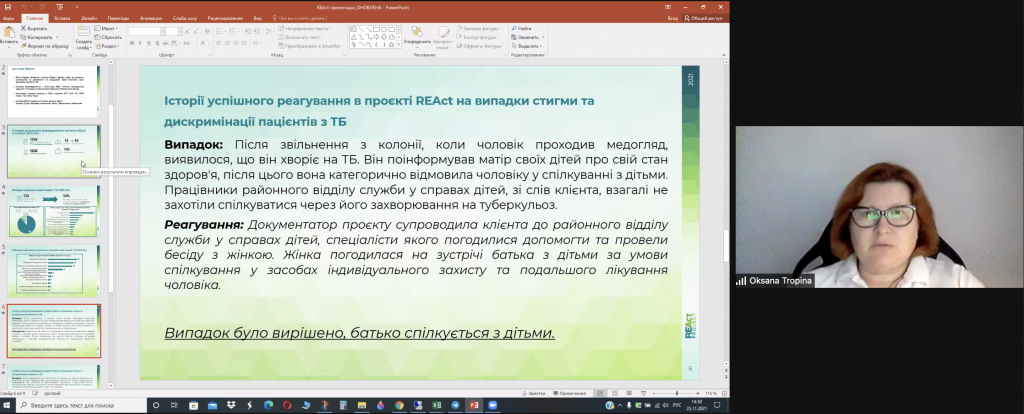
Oksana Tropina, a REActor, a SCO “Ukraine without tortures” member, presented two cases of successful response to address the violations of rights of key populations in Kherson oblast. The speaker noted that the system is actively used considering the large TB incidence in the region. Oksana said that there are quite many TB   patients in Penitentiary Facility # 7 in Kherson Oblast. After their release, they often face the realia they are not ready for. Often, they do not classify problems they encounter in obtaining services, as stigma and discrimination, therefore such cases demand special attention. 

The first case told by the REActor was about a man with TB who wanted to re-establish communication with his children upon release from the colony. The mother of the children reacted negatively, so he contacted the Service on child matters. The officials did not want to talk to him and closed the door in front of him after they heard about his disease. After that, the man contacted the REActor, who offered psychological support and conducted initial legal counseling. According to the man, reestablishing contact with children was the most important thing for him, so, together with Oksana, they approached the Service again for proper assistance. This time they negotiated a meeting with the former wife of the client. They talked, and she agreed to allow communication of the children with their father, upon condition that personal protection means are worn, and the man continues his treatment.

Презентація роботи системи REAct та історій успішного реагування на вебінарі щодо зниження рівня стигми та дискримінації по відношенню до осіб з ТБ

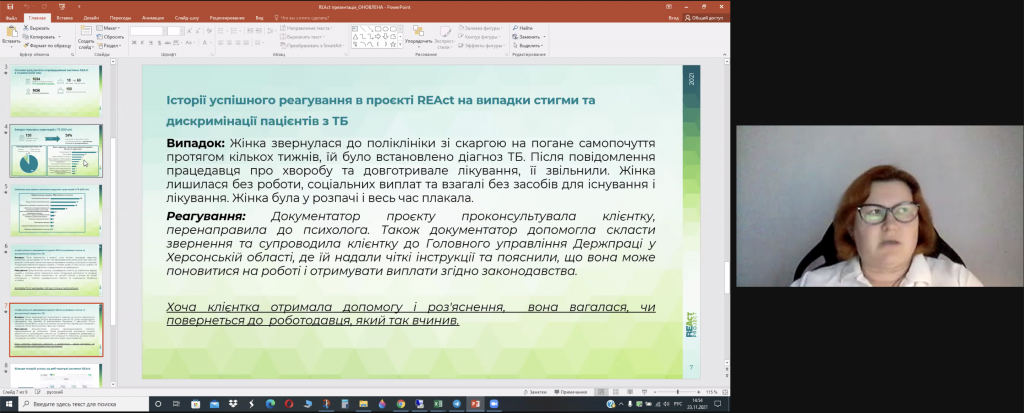
The other story was about a woman who was seeking care from the policlinic for she was not feeling well. Based on the results of the examination, she was diagnosed with TB. When her employer learned about her diagnosis, he started to pressure her and then told her to resign. At one moment the woman remained unemployed, without any means for living and treatment. She contacted the REActor for psychological and legal support. Together they decided to file a request to the Main Office of the State Labor Service, where the woman was provided clear explanations and instructions. The situation was positively resolved, and the woman continues working. 

Презентація роботи системи REAct та історій успішного реагування на вебінарі щодо зниження рівня стигми та дискримінації по відношенню до осіб з ТБ